
Strategies for Reducing Business Electricity Peak Demand Charges

Strategies for Reducing Business Electricity Peak Demand Charges

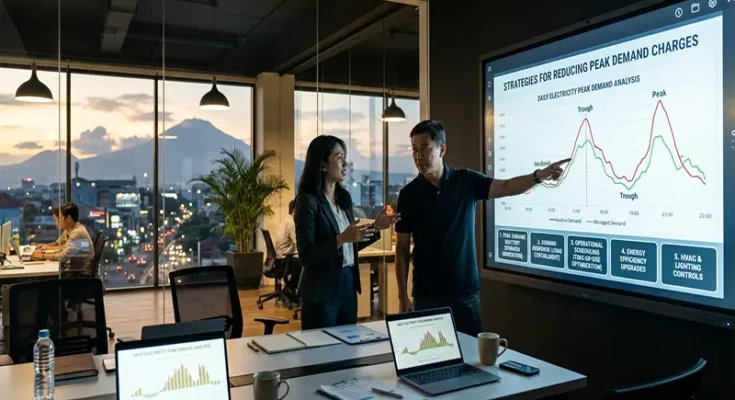
For many industrial facilities and commercial hubs, the monthly utility bill contains a frustrating paradox: even if total energy consumption decreases, the bill remains stubbornly high. The culprit is the Demand Charge. While most consumers are familiar with Consumption (the total amount of energy used), businesses are also billed for Demand (the maximum rate at which energy is drawn).

In the 2026 utility landscape, a single 15-minute window of high usage—perhaps caused by a simultaneous machine startup or an afternoon cooling surge—can dictate up to 70% of the entire month’s energy costs. This “peak” sets the price floor, regardless of how much energy is saved during the other 29 days.

Understanding the Difference

To manage these costs, stakeholders must distinguish between volume and velocity.

FeatureConsumption (kWh)Demand (kW)
AnalogyThe total distance traveled (Odometer)The maximum speed reached (Speedometer)
Billing BasisTotal energy used over a billing cycle
Strategies for Reducing Business Electricity Peak Demand Charges Read More
How to Build an AI-First Marketing Strategy Development Framework

How to Build an AI-First Marketing Strategy Development Framework

For the past decade, marketing leaders have treated artificial intelligence as a “bolt-on” utility—a faster way to write emails or a smarter way to bid on keywords. This “Legacy Plus AI” approach is rapidly hitting a ceiling of diminishing returns. As we navigate the 2026 landscape, the competitive frontier has shifted toward the AI-First paradigm.

An AI-First strategy is not defined by the number of LLM licenses a department holds, but by the extent to which AI serves as the foundation of the marketing engine. The core thesis of this shift is a move away from creative volume toward predictive precision. In an AI-First world, we do not simply create more content; we use an integrated intelligence layer to ensure that every touchpoint is a mathematically optimized response to a specific customer need, delivered at the exact moment of highest influence.

The 4 Pillars of the AI-First Framework

How to Build an AI-First Marketing Strategy Development Framework Read More
How to Build an Embedded Finance Business Model for Vertical SaaS Platforms

How to Build an Embedded Finance Business Model for Vertical SaaS Platforms

The evolution of software-as-a-service has reached a critical inflection point. In the SaaS 1.0 era, success was measured by subscription revenue (SaaS fee) and seat-based growth. However, as we move through 2026, we have entered the era of SaaS 2.0: the “FinTech-ization” of vertical software. The core thesis is simple: the platform that owns the operational workflow (the “system of record”) is the most logical and efficient place to deliver financial services. By embedding finance, Vertical SaaS platforms—whether serving construction, healthcare, or hospitality—can capture a significantly larger share of their customers’ total spend while creating deep-moat defensibility.

The Layered Business Model: Beyond Payments

For most platforms, the journey begins with payments, but the true enterprise value is unlocked as you move up the financial stack.

1. Payments: The Entry Point

Integrated payments are no longer a “feature”—they are the foundation. However, SaaS 2.0 platforms move beyond simple payment processing to …

How to Build an Embedded Finance Business Model for Vertical SaaS Platforms Read More
How to Use AI Utility Bill Auditing Software to Find Commercial Overcharges

How to Use AI Utility Bill Auditing Software to Find Commercial Overcharges

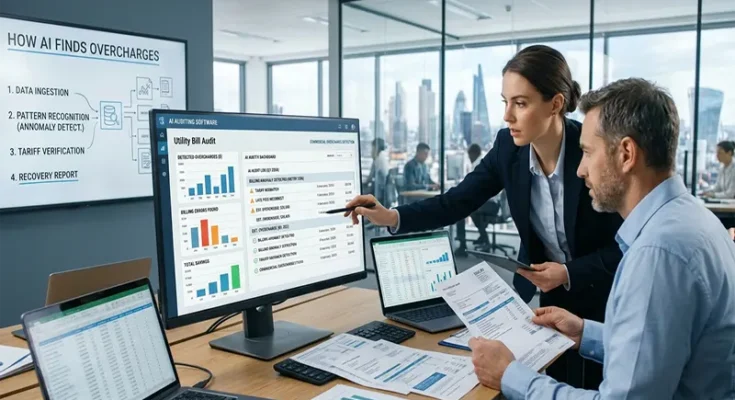
In the landscape of 2026 industrial operations, “financial leakage” has become one of the most significant yet preventable threats to the bottom line. Historically, utility expenses were viewed as a fixed cost of doing business—an unavoidable tax on production and commerce. However, empirical data now suggests that 15% to 20% of commercial utility invoices contain errors, ranging from simple clerical mistakes to complex tariff misapplications. For a large-scale industrial facility or a commercial real estate portfolio, this represents an “invisible leak” that can drain hundreds of thousands of dollars annually.

Manual auditing, once the industry standard, is no longer sufficient. The sheer volume of data, the volatility of energy markets, and the complexity of modern multi-provider billing cycles have made human-led spot checks obsolete. In 2026, AI-driven utility auditing has transitioned from a competitive advantage to a fundamental control function for operational excellence.

2026 Trend Watch: Real-time Adjudication

The …

How to Use AI Utility Bill Auditing Software to Find Commercial Overcharges Read More
Understanding the Investment Potential Ahead

A New Chapter for India’s Resource Giants: Understanding the Investment Potential Ahead

As India continues to balance economic growth with capital market reforms, the possible entry of Bharat Coking Coal IPO discussions into mainstream investor conversations has placed it firmly among the most watched Upcoming IPO prospects. This improvement indicator renewed self-assurance in large-scale public area listings and highlights the marketplace’s readiness to absorb companies that play a foundational function in the business framework.

Coking coal remains quintessential for metallic manufacturing, and India’s expanding infrastructure plans ensure a sustained call for this aid. Bharat Coking Coal’s operations are deeply integrated with home metal producers, giving it a strategic benefit over import-dependent alternatives. This integration no longer most effectively reduces foreign exchange outflows but additionally strengthens countrywide deliver protection, a growing concern in uncertain worldwide economic conditions.

One of the defining strengths of the business enterprise lies in its installed reserves and long operational history. Decades of mining experience have enabled it to …

A New Chapter for India’s Resource Giants: Understanding the Investment Potential Ahead Read More