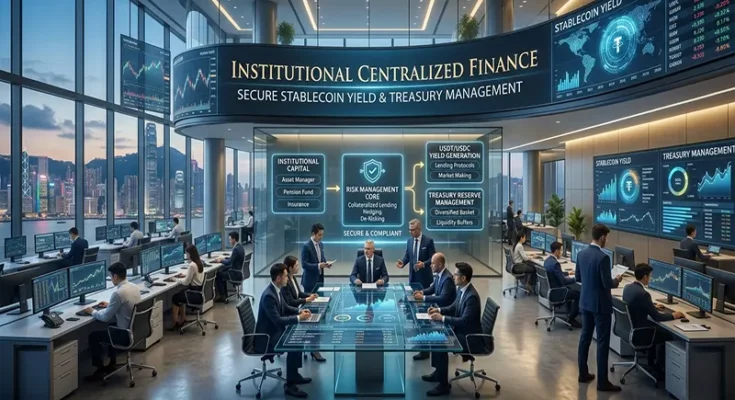
Institutional Centralized Finance (CeFi): A New Paradigm for Treasury Management

Institutional Centralized Finance (CeFi): A New Paradigm for Treasury Management

In the fiscal landscape of 2026, corporate treasurers face a persistent “Yield Gap.” While traditional cash equivalents like T-Bills and Money Market Funds provide a baseline of security, their returns often struggle to outpace the real-world costs of capital in a volatile economy. This has led to the institutionalization of Centralized Finance (CeFi).

Stablecoins—specifically those pegged to the USD—are no longer viewed as speculative vehicles. They have matured into the “Digital Dollar” infrastructure, providing a high-velocity rail for treasury management. The core thesis for the 2026 CFO is clear: by integrating institutional CeFi, a firm can capture premium yield while maintaining the liquidity and safety profiles mandated by board-level investment policies.

The Institutional CeFi Business Model: Beyond Retail Speculation

The primary hurdle for institutional entry has been the conflation of “Retail DeFi” with “Institutional CeFi.” The distinction is fundamental to risk management.

The Delta: Retail vs. Institutional

Retail …

Institutional Centralized Finance (CeFi): A New Paradigm for Treasury Management Read More

Private Credit vs. Traditional Bank Lending: The Mid-Market Paradigm Shift

Private Credit vs. Traditional Bank Lending: The Mid-Market Paradigm Shift

We are witnessing a “Great Migration” in corporate finance. Historically, the mid-market—companies with revenues between $50 million and $1 billion—depended almost exclusively on commercial and regional banks for growth capital. However, as we move through 2026, a fundamental decoupling has occurred. Debt is migrating from bank balance sheets to private investment vehicles.

The core of this shift lies in the funding source. Banks are deposit-funded and, as a result, are subject to intense regulatory scrutiny and capital reserve requirements. Private credit, by contrast, is investor-funded, drawing from deep pools of “dry powder” provided by institutional Limited Partners (LPs) like pension funds and insurance companies. In the current economic climate, mid-market CFOs are increasingly prioritizing “Certainty of Execution”—the guarantee that a deal will close on the agreed terms—over securing the absolute lowest interest rate.

The Structural Divide: Regulation vs. Agility

The divergent paths of these two models are largely …

Private Credit vs. Traditional Bank Lending: The Mid-Market Paradigm Shift Read More
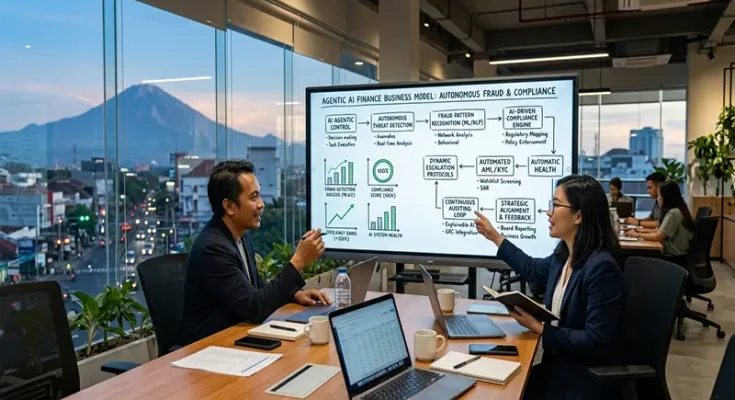
Transition to an Agentic AI Finance Business Model for Autonomous Fraud and Compliance

Transition to an Agentic AI Finance Business Model for Autonomous Fraud and Compliance

In the executive suites of 2026, the conversation has shifted. We are no longer discussing “automation”—a term that defined the previous decade of static, rules-based efficiency. Today, the focus is on Agentic AI. While traditional automation relies on “if-then” logic to execute repetitive tasks, Agentic Systems are goal-oriented. They possess the capacity to reason, plan, and utilize a suite of digital tools to achieve complex objectives autonomously.

For the modern CFO and Chief Risk Officer, this transition represents a fundamental change in the finance business model. The “Back Office” is no longer a necessary cost center of human reviewers battling an endless tide of alerts. Instead, it is becoming an autonomous, self-healing profit-protection engine. In this new model, AI doesn’t just flag a problem; it resolves it.

The Shift: From Detection to Autonomous Resolution

The primary weakness of legacy fraud systems was their rigidity. Static rules are easily bypassed …

Transition to an Agentic AI Finance Business Model for Autonomous Fraud and Compliance Read More
How to Build an Embedded Finance Business Model for Vertical SaaS Platforms

How to Build an Embedded Finance Business Model for Vertical SaaS Platforms

The evolution of software-as-a-service has reached a critical inflection point. In the SaaS 1.0 era, success was measured by subscription revenue (SaaS fee) and seat-based growth. However, as we move through 2026, we have entered the era of SaaS 2.0: the “FinTech-ization” of vertical software. The core thesis is simple: the platform that owns the operational workflow (the “system of record”) is the most logical and efficient place to deliver financial services. By embedding finance, Vertical SaaS platforms—whether serving construction, healthcare, or hospitality—can capture a significantly larger share of their customers’ total spend while creating deep-moat defensibility.

The Layered Business Model: Beyond Payments

For most platforms, the journey begins with payments, but the true enterprise value is unlocked as you move up the financial stack.

1. Payments: The Entry Point

Integrated payments are no longer a “feature”—they are the foundation. However, SaaS 2.0 platforms move beyond simple payment processing to …

How to Build an Embedded Finance Business Model for Vertical SaaS Platforms Read More
Understanding the Investment Potential Ahead

A New Chapter for India’s Resource Giants: Understanding the Investment Potential Ahead

As India continues to balance economic growth with capital market reforms, the possible entry of Bharat Coking Coal IPO discussions into mainstream investor conversations has placed it firmly among the most watched Upcoming IPO prospects. This improvement indicator renewed self-assurance in large-scale public area listings and highlights the marketplace’s readiness to absorb companies that play a foundational function in the business framework.

Coking coal remains quintessential for metallic manufacturing, and India’s expanding infrastructure plans ensure a sustained call for this aid. Bharat Coking Coal’s operations are deeply integrated with home metal producers, giving it a strategic benefit over import-dependent alternatives. This integration no longer most effectively reduces foreign exchange outflows but additionally strengthens countrywide deliver protection, a growing concern in uncertain worldwide economic conditions.

One of the defining strengths of the business enterprise lies in its installed reserves and long operational history. Decades of mining experience have enabled it to …

A New Chapter for India’s Resource Giants: Understanding the Investment Potential Ahead Read More