
Ethical Marketing Strategy Development for Mission-Driven Consumer Brands

Ethical Marketing Strategy Development for Mission-Driven Consumer Brands

In 2026, the marketplace is defined by a profound “Trust Deficit.” The era of vague, feel-good “cause marketing” has ended, as Gen Z and Gen Alpha consumers—equipped with sophisticated AI-driven research tools—can detect “purpose-washing” in seconds. Traditional campaigns that treat ethics as an aesthetic layer are being rejected in favor of brands that demonstrate a Supply-Chain-to-Storytelling continuum.

The core thesis for a mission-driven brand is that ethical marketing is not a department or a seasonal campaign; it is a fundamental operational commitment. True brand integrity is found where the marketing message is an unedited reflection of the brand’s internal realities.

The Framework of Radical Transparency

To win in this environment, brands must transition from “Black Box” operations to “Glass Box” transparency.

The “Glass Box” Brand

A “Glass Box” brand is one that invites the consumer to look inside. This means going beyond high-level mission statements to provide SKU-level data. In …

Ethical Marketing Strategy Development for Mission-Driven Consumer Brands Read More
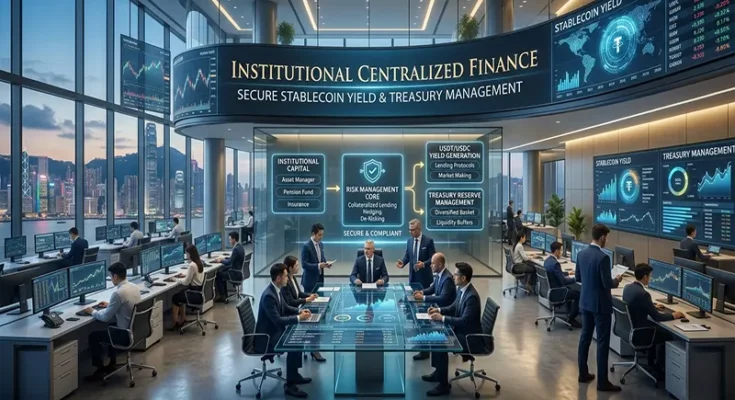
Institutional Centralized Finance (CeFi): A New Paradigm for Treasury Management

Institutional Centralized Finance (CeFi): A New Paradigm for Treasury Management

In the fiscal landscape of 2026, corporate treasurers face a persistent “Yield Gap.” While traditional cash equivalents like T-Bills and Money Market Funds provide a baseline of security, their returns often struggle to outpace the real-world costs of capital in a volatile economy. This has led to the institutionalization of Centralized Finance (CeFi).

Stablecoins—specifically those pegged to the USD—are no longer viewed as speculative vehicles. They have matured into the “Digital Dollar” infrastructure, providing a high-velocity rail for treasury management. The core thesis for the 2026 CFO is clear: by integrating institutional CeFi, a firm can capture premium yield while maintaining the liquidity and safety profiles mandated by board-level investment policies.

The Institutional CeFi Business Model: Beyond Retail Speculation

The primary hurdle for institutional entry has been the conflation of “Retail DeFi” with “Institutional CeFi.” The distinction is fundamental to risk management.

The Delta: Retail vs. Institutional

Retail …

Institutional Centralized Finance (CeFi): A New Paradigm for Treasury Management Read More
Lowering Commercial Utility Bills Through Carbon-Free Energy (CFE) 24/7 Contracts

Lowering Commercial Utility Bills Through Carbon-Free Energy (CFE) 24/7 Contracts

In the sustainability landscape of 2026, the era of “carbon offsets” and annual renewable energy matching is coming to a close. For years, corporations achieved “100% renewable” status by purchasing Renewable Energy Certificates (RECs) to match their total yearly consumption. However, this model ignores a fundamental physical reality: the sun does not always shine, and the wind does not always blow. If a company uses power at 2:00 AM but only buys solar credits from a mid-day peak, they are still relying on fossil-fuel peaking plants for their actual real-time needs.

24/7 Carbon-Free Energy (CFE) is the new institutional standard. It requires “Real-Time Matching”—the commitment to match every kilowatt-hour of electricity consumed, in every hour of the day, on every grid where a company operates, from local carbon-free sources. As local governments implement stricter “Scope 2” reporting and carbon penalties, 24/7 CFE has transitioned from a visionary goal to a …

Lowering Commercial Utility Bills Through Carbon-Free Energy (CFE) 24/7 Contracts Read More
Integrated Sales and Marketing: Developing a Unified ABM Strategy

Integrated Sales and Marketing: Developing a Unified ABM Strategy

In the enterprise B2B environment of 2026, the traditional hand-off from Marketing to Sales is no longer just inefficient—it is a liability. Account-Based Marketing (ABM) has evolved from a niche marketing tactic into a Unified Revenue Motion. Companies that continue to operate in silos pay a “Silo Tax,” manifesting as inconsistent brand narratives, wasted ad spend on disinterested accounts, and missed expansion opportunities.

The core thesis of a modern integrated strategy is that ABM success is not measured by the volume of leads generated, but by the “Tightness of the Hand-off.” When Sales and Marketing act as a single unit, they move from catching fish with a broad net to a coordinated strike on high-value targets.

The Foundation: An Integrated ICP and TAL

The first step in breaking down silos is the collaborative creation of the Ideal Customer Profile (ICP) and the resulting Target Account List (TAL).

In …

Integrated Sales and Marketing: Developing a Unified ABM Strategy Read More
Private Credit vs. Traditional Bank Lending: The Mid-Market Paradigm Shift

Private Credit vs. Traditional Bank Lending: The Mid-Market Paradigm Shift

We are witnessing a “Great Migration” in corporate finance. Historically, the mid-market—companies with revenues between $50 million and $1 billion—depended almost exclusively on commercial and regional banks for growth capital. However, as we move through 2026, a fundamental decoupling has occurred. Debt is migrating from bank balance sheets to private investment vehicles.

The core of this shift lies in the funding source. Banks are deposit-funded and, as a result, are subject to intense regulatory scrutiny and capital reserve requirements. Private credit, by contrast, is investor-funded, drawing from deep pools of “dry powder” provided by institutional Limited Partners (LPs) like pension funds and insurance companies. In the current economic climate, mid-market CFOs are increasingly prioritizing “Certainty of Execution”—the guarantee that a deal will close on the agreed terms—over securing the absolute lowest interest rate.

The Structural Divide: Regulation vs. Agility

The divergent paths of these two models are largely …

Private Credit vs. Traditional Bank Lending: The Mid-Market Paradigm Shift Read More