
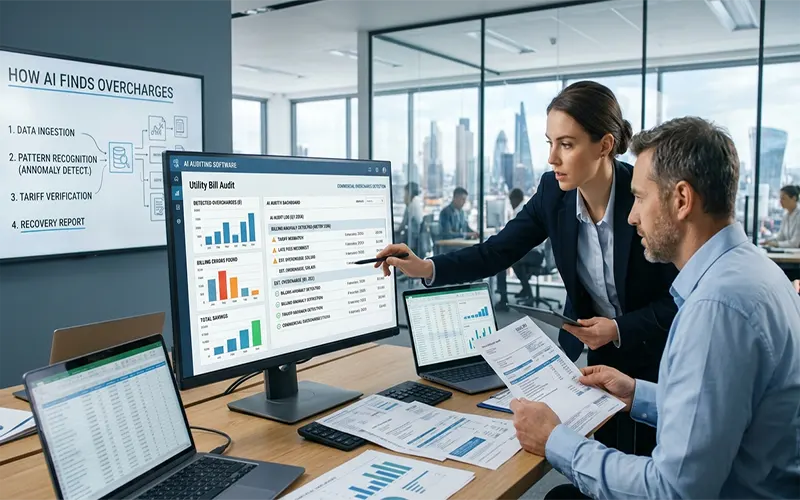
In the landscape of 2026 industrial operations, “financial leakage” has become one of the most significant yet preventable threats to the bottom line. Historically, utility expenses were viewed as a fixed cost of doing business—an unavoidable tax on production and commerce. However, empirical data now suggests that 15% to 20% of commercial utility invoices contain errors, ranging from simple clerical mistakes to complex tariff misapplications. For a large-scale industrial facility or a commercial real estate portfolio, this represents an “invisible leak” that can drain hundreds of thousands of dollars annually.
Manual auditing, once the industry standard, is no longer sufficient. The sheer volume of data, the volatility of energy markets, and the complexity of modern multi-provider billing cycles have made human-led spot checks obsolete. In 2026, AI-driven utility auditing has transitioned from a competitive advantage to a fundamental control function for operational excellence.
2026 Trend Watch: Real-time Adjudication
The industry is shifting from “post-audit” recovery toward real-time adjudication. Modern AI systems now intercept electronic invoices the moment they are generated, flagging discrepancies before payment is authorized, effectively eliminating the need for lengthy “claw-back” negotiations with utility providers.
The AI Difference: Beyond Manual Spot-Checks
Traditional utility auditing often relied on retrospective reviews performed once or twice a year. AI-driven software operates on a principle of Continuous Monitoring. It doesn’t just look for errors; it understands the context of the usage through two core technical advancements:
AI-OCR Ingestion
The primary hurdle in utility auditing has always been data fragmentation. Invoices come in varying formats—PDFs, EDI files, or paper—across different providers. AI-driven Optical Character Recognition (OCR) and Natural Language Processing (NLP) now ingest and normalize this data with near-perfect accuracy, standardizing disparate billing units into a single, actionable data lake.
Machine Learning Baseline Modeling
AI creates a “digital twin” of a facility’s energy profile. By integrating external data—such as hyper-local weather patterns, occupancy sensors, and 2026 production schedules—the algorithm establishes a baseline of “expected usage.” When actual usage deviates from this baseline without a logical operational correlate, the system immediately flags a potential overcharge or equipment failure.
Top 5 Overcharges AI Detects
While human auditors might catch a duplicate bill, AI identifies structural errors hidden deep within the line items:
- Tariff Misclassification: AI monitors utility rate changes in real-time and flags when a facility is billed on a “General Service” rate despite qualifying for a lower-cost “Industrial” or “Time-of-Use” tariff.
- Demand Spikes & Ratchet Clauses: Many commercial contracts include “ratchet” clauses where a single 15-minute spike sets a high billing floor for the next year. AI identifies if the spike was a billing anomaly or a preventable operational error.
- Shadow Billing & Duplicate Metering: AI cross-references active lease data with utility account IDs to purge overlapping service periods or charges for closed locations.
- Automated Tax Exemptions: Many industrial operations are eligible for sales tax exemptions on manufacturing energy. AI automates the recovery of these credits by identifying qualifying usage patterns.
- Meter Drift Detection: If a physical meter fails, it results in “Impossible Reading” logic. AI detects these anomalies, allowing facility managers to demand retroactive credits.
The 4-Step Implementation Workflow
Implementing an AI auditing layer follows a structured tactical workflow:
- Step 1: Data Normalization & API Integration: Connecting the AI software to utility portals via API or secure EDI feeds ensures a “zero-touch” flow of data.
- Step 2: Training the Algorithm: The system ingests 24–36 months of historical data to learn the facility’s unique seasonal patterns and identify historical errors still eligible for recovery.
- Step 3: Exception Management: The finance team only interacts with the software when a “High-Priority” flag is generated, ranked by financial impact and confidence score.
- Step 4: Adjudication: The AI generates an evidence-based “Proof of Claim” packet to be submitted to the utility provider for a refund or credit.
The ROI & ESG Connection
In 2026, auditing data serves a dual purpose. Beyond financial recovery, this granular data feeds directly into ESG reporting and decarbonization strategies. By identifying “ghost usage” or equipment inefficiencies, organizations identify waste before it becomes a carbon footprint.
Technical Checklist for AI Partner Selection
- Security: SOC2 Type II compliance to protect sensitive operational data.
- Integration: Native API depth with national and regional utility providers.
- Intelligence: Ability to integrate external variables (weather, occupancy) rather than just basic rules-based logic.
- Financial Model: Availability of an initial “no-risk” historical lookback audit.
Utility billing should no longer be treated as an unavoidable expense, but as a rich source of financial data. By deploying AI utility bill auditing, organizations establish a culture of precision that protects the bottom line while driving the transparency required for the modern industrial landscape.