
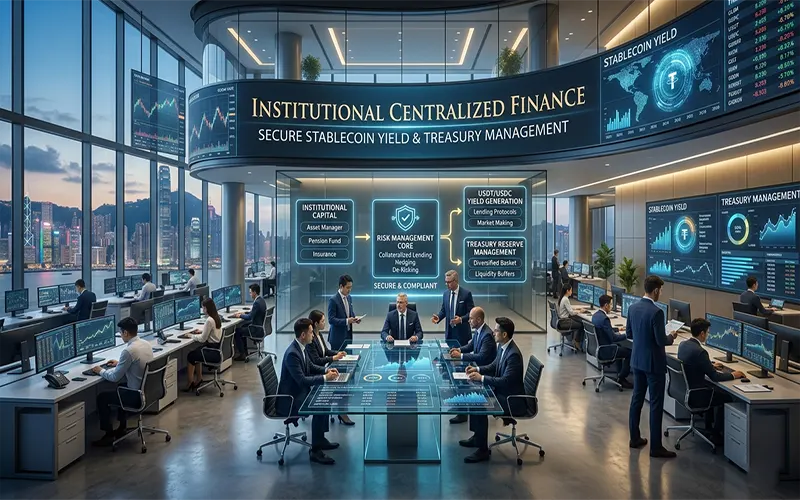
In the fiscal landscape of 2026, corporate treasurers face a persistent “Yield Gap.” While traditional cash equivalents like T-Bills and Money Market Funds provide a baseline of security, their returns often struggle to outpace the real-world costs of capital in a volatile economy. This has led to the institutionalization of Centralized Finance (CeFi).
Stablecoins—specifically those pegged to the USD—are no longer viewed as speculative vehicles. They have matured into the “Digital Dollar” infrastructure, providing a high-velocity rail for treasury management. The core thesis for the 2026 CFO is clear: by integrating institutional CeFi, a firm can capture premium yield while maintaining the liquidity and safety profiles mandated by board-level investment policies.
The Institutional CeFi Business Model: Beyond Retail Speculation
The primary hurdle for institutional entry has been the conflation of “Retail DeFi” with “Institutional CeFi.” The distinction is fundamental to risk management.
The Delta: Retail vs. Institutional
Retail platforms often rely on high-leverage, uncollateralized lending and algorithmic stablecoins—models that are inherently prone to “bank runs.” Institutional CeFi, by contrast, is built on a foundation of audited, over-collateralized lending and strict compliance. It operates as a regulated bridge between the efficiency of on-chain assets and the stability of traditional finance.
Mechanics of Yield Generation
Institutional yield is not “magic”; it is derived from specific, low-risk market activities:
- Delta-Neutral Market Making: Capturing the spread between spot and futures markets without taking a directional “bet” on price movement.
- Over-Collateralized Lending: Providing liquidity to institutional borrowers (such as hedge funds) who must post $1.20 or $1.50 in liquid collateral for every $1.00 borrowed.
- Liquidity Provision: Earning fees by providing the deep liquidity necessary for large-scale institutional swaps in regulated digital environments.
Risk Mitigation & Security: The “Safety Stack”
For a corporate treasurer, the return of capital is more important than the return on capital. In 2026, the institutional “Safety Stack” has become standardized.
Custody and Compliance
The foundation of secure CeFi is MPC (Multi-Party Computation) Custody. This technology ensures that private keys are never held in a single location, eliminating the “single point of failure” risk. Furthermore, institutional partners must demonstrate SOC2 Type II Compliance, proving that their internal controls for data security and privacy are rigorously audited.
Counterparty Risk and Collateral “Haircuts”
To protect principal, institutional platforms employ aggressive “haircuts.” If a borrower provides an asset as collateral, the lender may only value it at 70% of its market price to account for potential volatility. This buffer ensures that even in a market downturn, the loan remains fully backed.
The 2026 Stablecoin Audit Standard
The industry has moved past “monthly attestations.” The current gold standard is Real-Time Reserve Attestation, where third-party auditors provide a 24/7 digital dashboard showing that every digital dollar is backed 1:1 by highly liquid, cash-equivalent reserves.
Treasury Integration: The Hybrid “Liquidity Ladder”
Modern treasury management does not require an “all-in” approach to digital assets. Instead, firms are adopting a hybrid Liquidity Ladder.
- Tier 1 (70%): Traditional T-Bills and Cash—ensuring absolute liquidity for immediate OpEx.
- Tier 2 (30%): Institutional CeFi Stablecoin Yield—generating alpha on “idle” cash that is not needed for 30–90 days.
On/Off-Ramp Efficiency
A key component of this integration is the efficiency of the “Ramp.” In 2026, institutional partners provide 24/7 instant conversion between Fiat (USD/EUR) and Stablecoins (USDC/USDT). This ensures that digital yield can be converted back into operational cash within minutes, not days.
| Feature | Traditional Treasury | Institutional CeFi |
| Primary Yield Source | Government Debt / Repo | Collateralized Lending / Market Making |
| Typical Yield (2026) | 3.5% – 4.5% | 7.0% – 10.0% |
| Liquidity | T+1 to T+2 | Near-Instant (24/7) |
| Transparency | Monthly Statements | Real-time On-chain Attestations |
Compliance & Regulatory Alignment
The 2026 landscape is defined by Regulatory Clarity. The implementation of MiCA (Markets in Crypto-Assets) in Europe and comprehensive stablecoin legislation in the US has provided the legal “safe harbor” institutional investors required. These frameworks ensure that stablecoin issuers are treated with the same rigor as traditional commercial banks, mandating strict reserve management and consumer protection.
Security Due-Diligence Checklist
- [ ] Custody: Does the partner use MPC or cold-storage solutions with multi-sig requirements?
- [ ] Audit Trail: Can they provide a SOC2 Type II report and a history of clean financial audits?
- [ ] Insurance: Is there a dedicated insurance policy covering “slashing,” hacks, or private key loss?
- [ ] Collateral Management: What is the minimum collateralization ratio, and how are “margin calls” automated?
The “CFO of the Future” is no longer a passive observer of digital assets. By leveraging the institutional CeFi model, treasury leaders can bridge the yield gap without compromising their fiduciary duties. As the lines between traditional and on-chain finance continue to blur, the ability to manage a unified, multi-asset balance sheet will become the hallmark of a sophisticated corporate treasury. The infrastructure is ready; the alpha is there for those who prioritize security.