In the sustainability landscape of 2026, the era of “carbon offsets” and annual renewable energy matching is coming to a close. For years, corporations achieved “100% renewable” status by purchasing Renewable Energy Certificates (RECs) to match their total yearly consumption. However, this model ignores a fundamental physical reality: the sun does not always shine, and the wind does not always blow. If a company uses power at 2:00 AM but only buys solar credits from a mid-day peak, they are still relying on fossil-fuel peaking plants for their actual real-time needs.
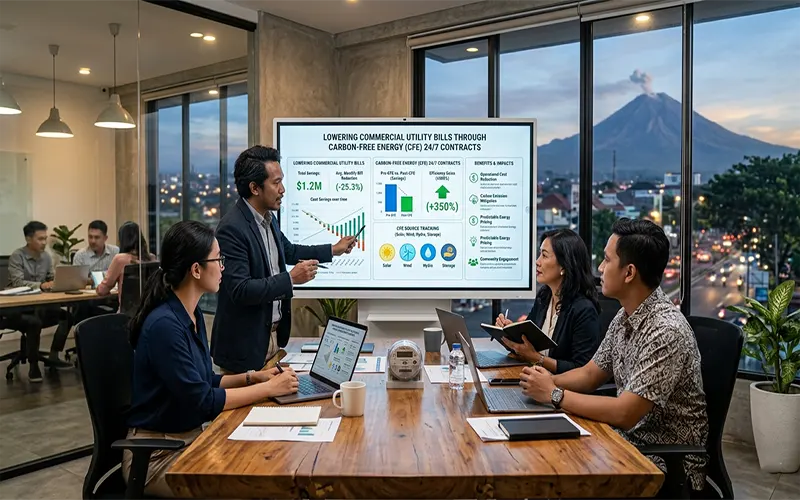
24/7 Carbon-Free Energy (CFE) is the new institutional standard. It requires “Real-Time Matching”—the commitment to match every kilowatt-hour of electricity consumed, in every hour of the day, on every grid where a company operates, from local carbon-free sources. As local governments implement stricter “Scope 2” reporting and carbon penalties, 24/7 CFE has transitioned from a visionary goal to a mechanical necessity for lowering long-term utility risk.
The Financial Logic of CFE 24/7
Transitioning to 24/7 CFE is as much a treasury strategy as it is an environmental one. By moving away from general grid power, which is often priced based on the most expensive marginal fuel source (usually natural gas), companies can achieve unprecedented price stability.
Hedging Against Volatility
Fossil-fuel-based peaking plants are subject to extreme price volatility driven by geopolitical events and supply chain constraints. 24/7 CFE contracts, structured as long-term Power Purchase Agreements (PPAs), allow a firm to lock in fixed rates for carbon-free power. This creates a powerful hedge against the “price spikes” that occur when the grid is under stress.
From Variable Rates to Fixed Certainty
In a traditional utility model, the CFO is at the mercy of variable rate hikes. A 24/7 CFE contract shifts the energy procurement model from a volatile operational expense (OpEx) to a predictable, fixed-cost structure. In the 2026 market, where energy prices are increasingly tied to carbon-intensity, locking in CFE today prevents the “carbon-tax creep” expected in the coming decade.
| Feature | Annual Matching (Legacy) | 24/7 CFE (2026 Standard) |
| Grid Impact | Low; does not drive grid stability | High; incentivizes baseload clean energy |
| Transparency | Low (Annual averages) | High (Hourly verifiable data) |
| Price Stability | Vulnerable to fossil fuel spikes | Fixed-price PPA structures |
| Reporting | Estimated “Market-based” | Auditable “Location-based” |
The “Hourly Matching” Mechanism
Achieving 24/7 CFE requires a sophisticated “portfolio approach” to energy procurement. No single renewable source can cover the 24-hour cycle.
The Clean Energy Portfolio
Procurement managers must assemble a diversified mix of assets to ensure the “Carbon-Free Score” remains at 100% every hour:
- Solar: Provides the bulk of mid-day requirements.
- Wind: Often reaches peak generation during evening and night hours.
- Nuclear/Geothermal: Provides the “Baseload” foundation that never fluctuates.
- Long-Duration Storage (LDES): Batteries that discharge over 8–12 hours to bridge the gaps between variable generation.
Advanced Metering and AI
The “brain” of this system is Advanced Metering Infrastructure (AMI). In 2026, AI-driven platforms track a facility’s load profile in real-time, matching it against the production profiles of the contracted assets. This allows the system to identify “carbon-heavy hours”—the specific times when the clean portfolio is falling short—enabling procurement teams to adjust their mix or purchase specific hourly supplements.
Operational Implementation & Tech Stack
The transition to 24/7 CFE necessitates an upgrade in how energy data is handled and certified.
Granular Certificates (GCs)
The industry is moving away from the yearly REC toward Granular Certificates (GCs). Unlike a traditional REC, which represents 1 MWh of energy produced at some point in a year, a GC is timestamped and location-stamped. It proves that a specific MWh of carbon-free energy was injected into the same grid during the same hour it was consumed.
AI-Driven Load Shifting
Beyond procurement, companies are using Energy Management Systems (EMS) powered by AI to become active grid participants. If the EMS detects that the clean energy supply will be low during the 4:00 PM to 6:00 PM window, it can automatically “shift” non-critical loads—such as cooling a warehouse or charging a fleet of EVs—to an earlier or later hour when CFE is more abundant and cheaper.
Risk Management & Future-Proofing
In 2026, 24/7 CFE is the ultimate defense against the Emissions Penalty Hedge. Governments are increasingly moving toward “Location-Based” accounting for Scope 2 emissions. Companies that rely on annual matching may soon find their “Net Zero” claims invalidated by regulators who see the fossil fuels powering their overnight operations.
The 2026 Emissions Penalty Hedge
As carbon pricing matures, companies with 24/7 CFE contracts are effectively immune to “Carbon Border Adjustment Mechanisms” (CBAM) and local carbon fines. By proving 100% hourly clean energy usage, these firms avoid the financial penalties that will soon be levied against “Grey Energy” users during peak demand hours.
CFE Readiness Checklist
- [ ] Hourly Data Access: Can your current utility provide a “Green Button” data feed or hourly API access to your consumption?
- [ ] Regional Grid Analysis: What is the current “residual mix” of your local grid? How much “baseload” (Nuclear/Hydro) is already available?
- [ ] PPA Flexibility: Do your existing energy contracts allow for the integration of third-party storage or supplemental “hourly” credits?
- [ ] Storage Valuation: Have you modeled the ROI of onsite or front-of-the-meter storage to bridge your “Solar-Wind” gap?
The shift to 24/7 Carbon-Free Energy marks the end of “passive” sustainability. In 2026, energy is no longer just a utility; it is a granular, time-sensitive asset. By committing to real-time hourly matching, commercial leaders are doing more than just “greening” their operations—they are building a resilient, high-transparency financial framework that hedges against the volatility of an aging, fossil-fuel grid. The path to a true zero-carbon future is built one hour at a time.