
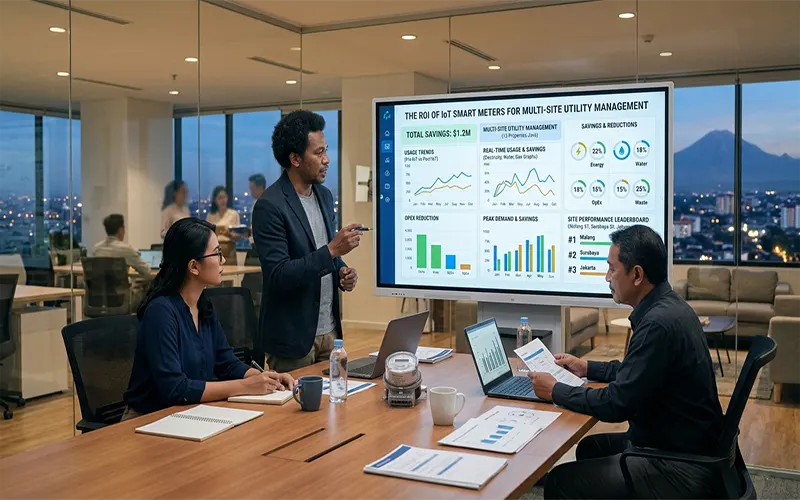
In the 2026 commercial real estate landscape, the “Visibility Gap” has become a multi-million dollar liability. For REITs and portfolio managers overseeing diversified assets across multiple geographies, the lack of real-time utility data creates a profound operational blind spot. Traditionally, utility management has been a reactive process, reliant on lagging monthly statements and manual oversight.
IoT smart meters represent a fundamental shift from this passive model. No longer merely a collection of hardware, smart meters function as the Nervous System of a modern property portfolio. They provide the granular, real-time pulse of energy, water, and gas consumption across thousands of miles, transforming utility data into a strategic financial asset.
The Direct ROI: Recovery and Accuracy
The most immediate financial impact of smart metering is the optimization of the revenue recovery cycle.
Automated Tenant Billing and Trust
In many legacy commercial leases, utility costs are allocated based on a pro-rata share of square footage. This “RUBS” (Ratio Utility Billing System) approach is inherently imprecise and often leads to tenant disputes, especially in mixed-use or industrial settings where high-intensity users effectively subsidize lower-intensity neighbors.
IoT sub-metering allows for Actual Usage Billing. By billing tenants exactly for what they consume, landlords can improve recovery ratios by capturing “leakage” from high-use tenants that was previously unallocated. Furthermore, providing tenants with a dashboard of their own consumption builds trust, reduces legal friction, and encourages self-managed energy conservation.
Eliminating Estimated Bills
Utility companies often rely on “estimated readings” when physical access to a meter is limited or staffing is low. These estimates are notoriously conservative, often resulting in significant over-billing that ties up capital in utility deposits or credits. IoT smart meters provide a “shadow meter” that verifies utility data with 99.9% accuracy, allowing finance teams to challenge over-estimates immediately and keep cash flow within the business.
| Feature | Manual Metering | IoT Smart Metering |
| Data Frequency | Monthly (at best) | Real-time (minute-by-minute) |
| Accuracy | Prone to human error/estimates | Digital precision (revenue-grade) |
| Recovery Strategy | Estimated/Pro-rata share | Direct actual consumption |
| Cost-to-Serve | High (Labor, travel, disputes) | Low (Automated, remote) |
The Indirect ROI: Operational Efficiency
Beyond billing, the ROI of IoT technology is realized through the prevention of catastrophic loss and the reduction of field labor.
Leak and Fault Detection
A single undetected water leak in a high-rise office or a malfunctioning HVAC unit in a retail center can cost tens of thousands of dollars in a single month. Traditional systems only catch these issues when a bill arrives or a physical failure occurs. IoT meters utilize “Anomalous Flow Logic”—if water is running at 3:00 AM in a closed office building, the system triggers an immediate alert. Catching a fault in hours rather than weeks prevents property damage and eliminates “wasted” utility spend.
Labor Savings and Remote Management
For multi-site operators, the cost of “sending a truck” to read meters or verify a reading is substantial. Smart meters eliminate the need for manual site visits. This shift reallocates hundreds of man-hours per year from low-value data collection to high-value proactive maintenance, significantly reducing the OpEx associated with portfolio-wide utility oversight.
The 2026 PropTech Integration Factor
Data without integration is just noise. Modern smart metering platforms now offer native API links to core real estate management systems like Yardi, MRI, and Salesforce. This allows utility data to flow directly into the general ledger, automating the entire “Meter-to-Cash” cycle without human intervention.
Strategic Value: The ESG and Valuation Play
In 2026, the value of a property is increasingly tied to its digital and environmental maturity.
Data for Decarbonization
High-fidelity data is the prerequisite for ESG reporting and GRESB (Global Real Estate Sustainability Benchmark) scoring. Institutional investors are increasingly divesting from assets that cannot prove their carbon footprint or water efficiency. Smart meters provide the “audit trail” required for green certifications, ensuring the portfolio remains attractive to ESG-conscious capital.
Boosting Asset Value (NAV)
The most compelling argument for the Investment Committee is the impact on Net Operating Income (NOI). Because every dollar saved in OpEx through smart metering is a direct dollar added to the NOI, the impact on the property’s valuation is multiplied by the market cap rate.
- Example: Reducing annual utility OpEx by $50,000 in a market with a 5% cap rate adds $1,000,000 to the property’s valuation.
Implementation Costs vs. Payback Period
While the initial CapEx for a portfolio-wide rollout can be significant, the payback period is remarkably compressed. Most multi-site commercial operators see a full return on investment within 18 to 36 months.
3-Year ROI Projection:
- Year 1: Hardware installation and data normalization. Initial recovery of “billing leakage” typically covers 30% of CapEx.
- Year 2: Realization of labor savings and leak prevention. Most portfolios reach the “Break-Even” point mid-year.
- Year 3: Full transition to positive cash flow per square foot. NOI increases are reflected in updated asset appraisals.
IoT smart metering is no longer an optional “green” initiative; it is the Digital Foundation of 2026 property strategy. By bridging the visibility gap, portfolio managers can protect their cash flow, empower their tenants, and significantly increase the market value of their assets. In a high-speed market, the most valuable square foot is the one you can measure in real-time.