
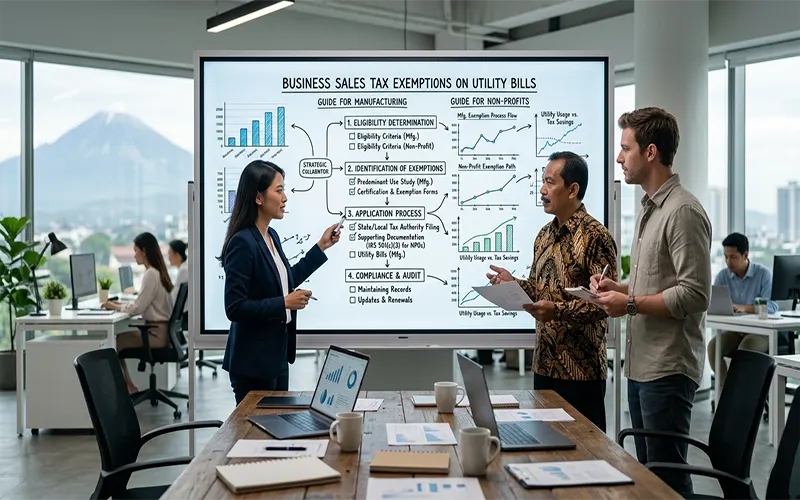
In the 2026 economic landscape, controlling operational expenditures is more critical than ever. While many organizations focus on labor or material costs, one of the most significant “invisible” expenses sits in the utility bill. Across the United States, billions of dollars in sales tax are paid annually on electricity, natural gas, and water by organizations that are legally eligible for exemptions.
For a mid-sized manufacturing plant or a high-capacity non-profit, these taxes can represent 5% to 10% of the total utility cost. Identifying and claiming these exemptions is not just a matter of “paperwork”—it is a strategic move that directly impacts the bottom line and funding availability.
The Manufacturing Exemption: Powering Production
Most states recognize that taxing the energy used to create a product leads to “tax pyramiding”—where the same item is taxed multiple times before reaching the consumer. To prevent this, dozens of states offer sales tax exemptions for utilities consumed in the manufacturing process.
The “Direct Use” Test
To qualify, the utility must generally be used “directly” in the production operation. This distinguishes between energy used to power a CNC machine (exempt) and energy used to light the administrative breakroom (taxable).
- Qualifying Usage: Power for production machinery, boilers, industrial ovens, compressors, and specialized climate control for sensitive materials.
- Non-Qualifying Usage: General office lighting, HVAC for administrative spaces, and outdoor parking lot illumination.
The Predominant Use Rule
One of the most powerful tools for manufacturers is the Predominant Use Rule. In states like Texas, Utah, and Virginia, if a single utility meter provides more than 50% of its energy to qualifying manufacturing equipment, the entire bill for that meter becomes 100% exempt from sales tax. In other states, such as Florida or Connecticut, the threshold may be higher (75%), or the exemption may be pro-rated based on exact usage percentages.
The Non-Profit Advantage: 501(c)(3) Exemptions
For non-profit organizations, the path to exemption is broader but often more strictly regulated at the application level. While a manufacturer’s exemption is based on how the energy is used, a non-profit’s exemption is typically based on the nature of the entity.
Direct Exemptions
In many jurisdictions, 501(c)(3) organizations are exempt from paying sales tax on any purchase made to further their charitable mission. This includes the electricity and gas required to run homeless shelters, community centers, and educational facilities.
Common Pitfalls for Non-Profits
- Entity Status: Not all non-profits qualify. In states like North Carolina, while many items are exempt for 501(c)(3)s, utilities like piped natural gas and electricity may still be subject to tax unless specifically carved out by local legislation.
- Separate Entities: If a non-profit operates a “for-profit” arm (like a gift shop or cafe), the utility usage for that specific footprint may be taxable, requiring a split-billing or percentage-based allocation.
Strategic Implementation: How to Claim Your Savings
Transitioning to an exempt status requires more than a simple phone call to the utility provider. It requires a documented, audit-defensible proof of eligibility.
1. The Predominant Use Study
For manufacturers, the gold standard is the Predominant Use Study. This is a professional engineering report that audits every piece of equipment in the facility to determine the exact ratio of production vs. non-production energy draw.
- 2026 Innovation: Modern studies now utilize IoT sub-metering and AI-driven load profiling to provide hyper-accurate data, which significantly reduces the risk of being overturned during a state audit.
2. The Exemption Certificate
Once eligibility is confirmed, the organization must file a state-specific Exemption Certificate (e.g., Form ST-121 in New York or 01-339 in Texas) with their utility provider. Once accepted, the utility company will stop charging the tax on future invoices.
3. Retroactive Refunds (The “Lookback”)
Perhaps the most significant opportunity lies in the past. Most states allow organizations to file for retroactive refunds on sales tax paid in error over the last 36 to 48 months. For an industrial facility spending $1M annually on utilities, a four-year lookback could result in a one-time windfall exceeding $250,000.
State-by-State Threshold Examples (2026 Snapshot)
| State | Exemption Threshold | Requirement |
| Texas | > 50% | 100% Exemption with Predominant Use Study |
| Florida | > 75% | Full exemption on electricity for production |
| Utah | > 50% | 100% Exemption; excludes municipal energy taxes |
| Kansas | Pro-rated | Exemption based on the % of energy “consumed in production” |
The 2026 Compliance Checklist
- [ ] Audit Current Invoices: Check the “Taxes and Fees” section. If you see “Sales Tax,” you are likely overpaying.
- [ ] Validate NAICS Codes: Ensure your business is correctly classified under Manufacturing (311-339) in state records.
- [ ] Review “Non-Production” Footprint: If your warehouse or office space is large compared to your production floor, you may need sub-metering to qualify.
- [ ] Check Expiration Dates: Many state exemption certificates expire every 3–5 years. Ensure yours is current.
Sales tax exemptions on utility bills represent one of the few areas where a business can permanently lower its costs without cutting services or headcount. By conducting a professional utility audit and maintaining rigorous compliance, manufacturers and non-profits can ensure they are no longer “donating” their hard-earned capital to the state in the form of unnecessary taxes. In 2026, every watt counts—but every tax dollar saved counts more.