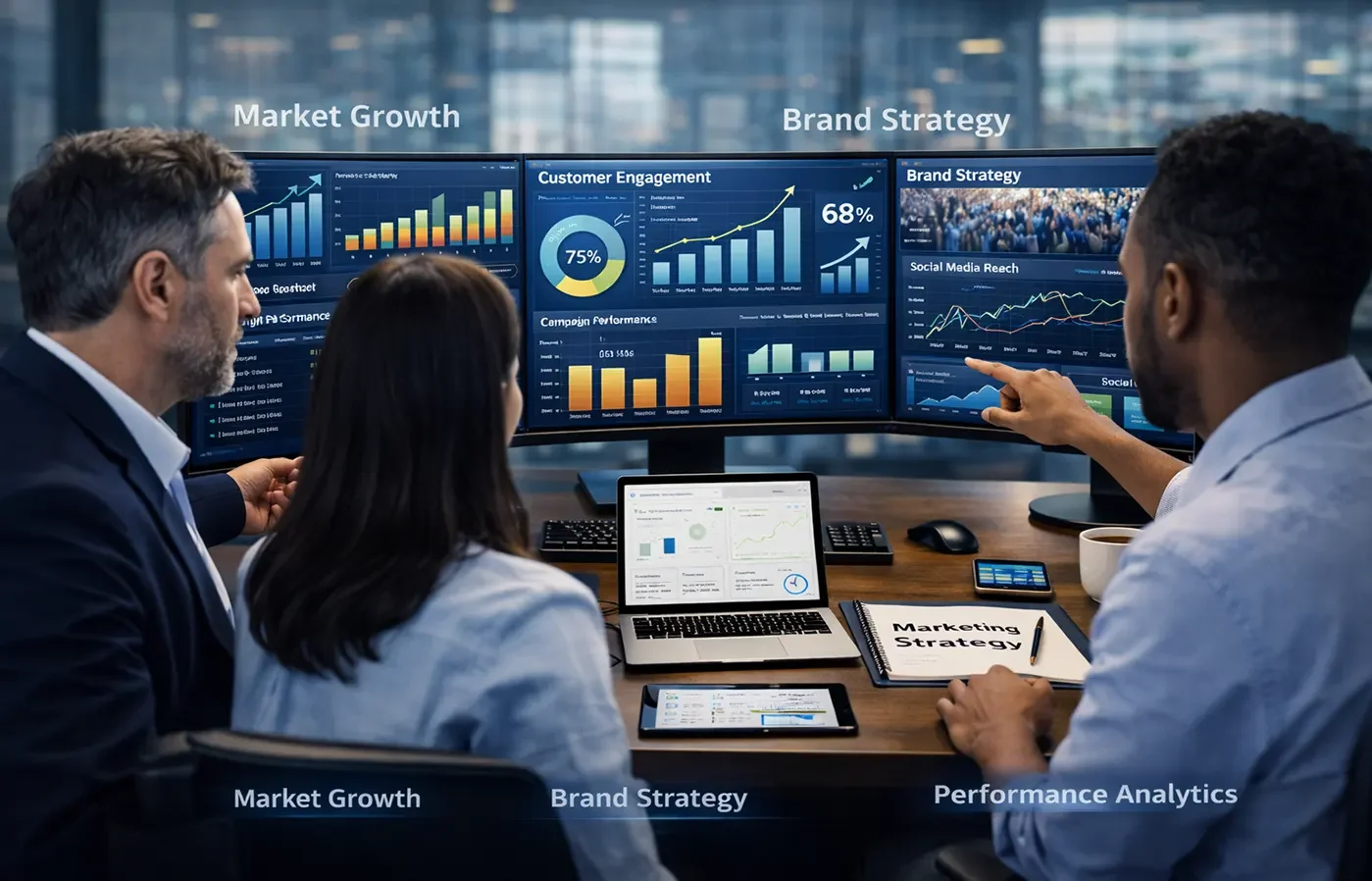

For the past decade, marketing leaders have treated artificial intelligence as a “bolt-on” utility—a faster way to write emails or a smarter way to bid on keywords. This “Legacy Plus AI” approach is rapidly hitting a ceiling of diminishing returns. As we navigate the 2026 landscape, the competitive frontier has shifted toward the AI-First paradigm.
An AI-First strategy is not defined by the number of LLM licenses a department holds, but by the extent to which AI serves as the foundation of the marketing engine. The core thesis of this shift is a move away from creative volume toward predictive precision. In an AI-First world, we do not simply create more content; we use an integrated intelligence layer to ensure that every touchpoint is a mathematically optimized response to a specific customer need, delivered at the exact moment of highest influence.
The 4 Pillars of the AI-First Framework
To move from theory to execution, organizations must restructure their marketing operations around four interconnected pillars.
1. Data Orchestration (The Foundation)
The effectiveness of any AI is limited by the quality and accessibility of the data it consumes. AI-First marketing replaces siloed CRM entries and disparate spreadsheet data with a unified Marketing Data Lake. This infrastructure ingests first-party signals, behavioral metadata, and market intelligence into a format that feeds Large Language Models (LLMs) and custom predictive models in real-time. Without this centralized “source of truth,” AI outputs remain generic and tactically disconnected.
2. Predictive Intelligence (The Brain)
Strategy development now begins with the “Brain.” By applying machine learning to the Data Lake, marketers can move beyond descriptive analytics (what happened) to Predictive Intelligence (what will happen). This includes high-fidelity lead scoring that predicts “propensity to buy,” churn modeling that identifies “at-risk” accounts weeks before they cancel, and dynamic Next Best Action (NBA) logic that dictates exactly what a customer should see next based on their unique journey.
3. Generative Content Lifecycle (The Muscle)
If predictive intelligence is the brain, generative AI is the “Muscle.” However, the AI-First framework moves beyond manual prompt engineering. Instead, it establishes Content Supply Chains. These are automated workflows where AI agents take the “Next Best Action” insights and instantly generate multi-channel assets—emails, landing pages, and social creative—tailored to the individual’s specific industry, pain points, and stage in the funnel.
4. Autonomous Optimization (The Nervous System)
The final pillar is the Nervous System of the strategy: a closed-loop feedback mechanism. AI-driven optimization engines perform continuous, multi-variable A/B testing at a scale impossible for human teams. They don’t just change button colors; they reallocate entire budgets across channels in real-time based on live performance data, ensuring that capital is always flowing toward the highest-return activities.
Building the “AI MarOps” Stack
Executing this framework requires a fundamental rethink of the Marketing Operations (MarOps) stack. The most significant evolution in 2026 is the rise of Agentic AI. Unlike traditional software that requires human input for every step, agentic workflows involve AI “agents” capable of executing multi-step tasks—such as researching a prospect, drafting a personalized whitepaper, and scheduling the delivery—autonomously.
When building the stack, leaders must choose between “All-in-One” AI suites or a “Composable” AI stack. While suites offer simplicity, a composable stack allows for “Best-in-Breed” flexibility, enabling teams to swap out specific LLMs or predictive engines as the technology evolves.
Critically, the stack must include a Human-in-the-Loop (HITL) protocol. Human intervention is no longer about doing the work; it is about governance. Humans serve as the ethical and brand-safety filters, ensuring that the autonomous engine remains aligned with the brand’s voice and regulatory requirements.
The Strategy Implementation Roadmap
Transitioning to an AI-First model is an evolutionary process that follows a 3-step rollout:
- Audit & Centralize: Begin by assessing data readiness. Identify where your customer data is siloed and establish the API connectivity required to feed an AI engine. Without a fluid data flow, the AI-First engine will stall.
- Pilot & Augment: Identify “High-Impact, Low-Risk” use cases. For many, this is email personalization or dynamic ad copy. Use these pilots to prove the ROI of predictive precision over manual creative efforts.
- Scale & Automate: Once the pilots are validated, transition to full-cycle autonomous management. This involves connecting the “Brain” directly to the “Muscle,” allowing the AI to generate and deploy campaigns with minimal human oversight.
The AI-First Marketing Flywheel
The success of this framework is visualized as a flywheel:
- Unified Data feeds into…
- Predictive Insights, which trigger…
- Automated Content Generation, which creates…
- Customer Interactions, which generate More Data, restarting the cycle at a higher level of precision.
Measuring Success in 2026: New Metrics
In the AI-First era, traditional KPIs like clicks, likes, and impressions are increasingly viewed as vanity metrics. They measure activity, not efficiency. To gauge the health of an AI-First strategy, leaders must track:
- Return on Data (ROD): The measurable revenue generated for every terabyte of customer data utilized by the AI.
- Efficiency of Personalization: The delta in conversion rates between AI-generated, hyper-personalized touchpoints and generic baseline content.
- Autonomous Output Ratio: The percentage of marketing tasks executed by agentic AI without direct human intervention.
Brand Safety Checklist for AI Outputs
- Hallucination Check: Does the output reference actual product features and valid pricing?
- Bias Filter: Has the content been screened for unintended demographic or cultural bias?
- Voice Alignment: Does the tone match the established brand guidelines stored in the AI’s “style memory”?
- Compliance Verification: Does the content adhere to industry-specific regulations (e.g., GDPR, CCPA, or financial disclosures)?
The transition to an AI-First marketing strategy is no longer optional; it is a prerequisite for survival in a hyper-automated market. Organizations that continue to view AI as an assistant will be outpaced by those that treat it as the architect. By focusing on data orchestration, predictive intelligence, and autonomous execution, marketing leaders can finally deliver on the decades-old promise of true 1-to-1 marketing at scale. The window to lead this transition is closing—the time to rebuild the engine is now.